|
C/2023 A3 (Tsuchinshan-ATLAS) lightcurve
Nick James
(31 Oct 2025 18:39 UTC)
|
|
Re: [BAA Comets] C/2023 A3 (Tsuchinshan-ATLAS) lightcurve
Thomas Lehmann
(31 Oct 2025 19:35 UTC)
|
|
Re: [BAA Comets] C/2023 A3 (Tsuchinshan-ATLAS) lightcurve
Nick James
(31 Oct 2025 19:53 UTC)
|
|
Re: [BAA Comets] C/2023 A3 (Tsuchinshan-ATLAS) lightcurve Thomas Lehmann (01 Nov 2025 11:46 UTC)
|
|
3IATLAS
David Reynolds
(31 Oct 2025 23:52 UTC)
|
|
Re: [BAA Comets] 3IATLAS
Douglas Heggie
(02 Nov 2025 21:03 UTC)
|
|
Re: [BAA Comets] 3IATLAS
Nick James
(02 Nov 2025 22:10 UTC)
|
|
RE: [BAA Comets] 3IATLAS
Guy Hurst
(13 Nov 2025 16:04 UTC)
|
Nick,

you are absolutely right, those 9" data are very useful to trace any short time
varability - at much better S/N than total coma magnitudes are able to provide.

My comment was focusing on the pre-perihelon lightcurve only (limited to
terrestrial observations), which does not show substantial oddities in my
opinion and can probably be fit altogether. Let me describe it in more detail.

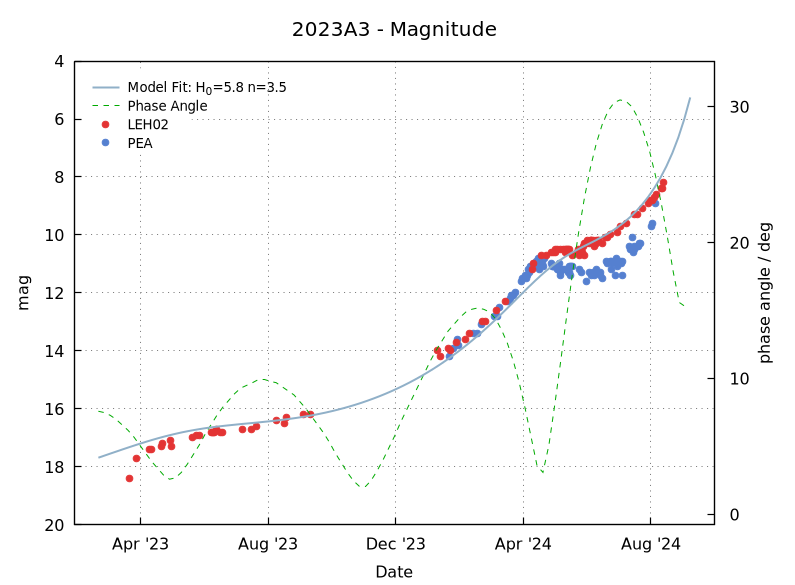
First of all there is a systematic difference between small aperture
measurements and large aperture measurements on dust-rich comets due to the
different amount of dust tail contribution. Not only there is an offset between
both data sets, but also the projection effect of the tail orientation with
respect to the line of sight may have significant impact.
An example is shown in the attached first figure 2023A3.mag_observed.png by
plotting the measurements of A. Peach (PEA) using rather small aperture and
myself (LEH02) using large aperture photometry. My own flux measurements are
incorporating a larger fraction of the tail and therefore are much less affected
by the projection effect which is well seen in both the data by PEA and in the
9 arcsec data shown in your plot.

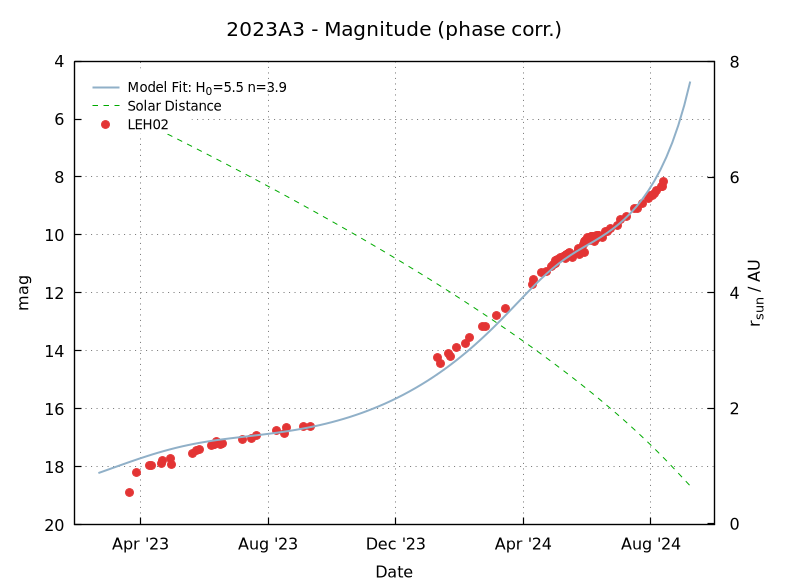
The other important enhancement of flux is due to backscattering near
opposition. In the lightcurve plotting program of my AIRTOOLS software I am
using the phase angle correction as provided by D. Schleicher (2010) in
  https://asteroid.lowell.edu/comet/dustphase
Taking my own data - essentially free of the projection effect - and applying
the phase correction, normalized to a correction of 0 mag at phase angle of 20°,
results in a pre-perihelion lightcurve given in figure
2023A3.mag_phase_corr.png.

The final phase corrected curve appears pretty normal but certainly there are
some small deviations from the standard magnitude model fitted by a single
constant activity parameter over the whole time span considered.

Thomas

> Am Fri, 31 Oct 2025 19:53:02 +0000
> schrieb Nick James <ndj@nickdjames.com>:
>
> Thomas,
>
> Yes, I agree that there is almost certainly a fairly complex log(d) term
> in the fit which is not currently in these curves but the small aperture
> magnitudes show changing biases even over quite small changes in d so it
> would be useful to understand what is going on.
>
> The amount of scatter in the small aperture photometry is very small
> compared to the total magnitude estimates on COBS so it is easier to see
> short-term changes in trends. I don't think that the coma outside the 9
> arcsec radius can be the full story here since the lightcurve is clearly
> very asymmetrical. There is also something odd going on in mid 2025
> November which is not obvious in the COBS total mags or coma diameter
> estimates. That is why I think it is useful to try to model these small
> aperture measurements.
>
> I'd be very interested if you could point me to the model that you used
> for the phase effect so that I can incorporate this into my analysis. In
> particular, over what period do you think that the phase enhancement was
> significant (say > 0.1 mag).
>
> Thanks,
>
> Nick.
>
> On 31/10/2025 19:35, Thomas Lehmann - t.lehmann at mailbox.org (via
> baa-comet list) wrote:
> >
> > Hi Nick,
> >
> > in my opinion, it is somewhat difficult to use those 9" measurement for an
> > overall analysis of lightcurves if the distance of the comet from earth is
> > changing a lot within the time frame considered.
> > E.g. in case of C/2023 A3 this distance decreased by more than a factor of 3
> > between 2023 April and 2024 June. The early mesurements are therefore tracing
> > a much larger volume of the coma and appear brighter by large amount (1-2 mag).
> > The lightcurve will be skewed a lot and deriving model parameters similar to
> > total coma magnitude lightcurves should be considered with caution.
> >
> > The peak in April is mostly affected by the phase effect as you mentioned, but
> > also by the projection of the dust tail within the mesurement aperture during
> > that time.
> >
> > Best regards
> > Thomas
> >
> >
> >
> >> Am Fri, 31 Oct 2025 18:38:49 +0000
> >> schrieb Nick James <ndj@nickdjames.com>:
> >>
> >> With all the current excitement about C/2025 A6 (Lemmon) we shouldn't
> >> forget the much brighter comet that we had this time last year. C/2023
> >> A3 was a really impressive naked-eye object in mid-October 2024 but it
> >> has now faded to around 18th magnitude although it is still available in
> >> the evening sky.
> >>
> >> In response to a query from Jonathan Shanklin I have updated the 9
> >> arcsec lightcurve. The lightcurve of this comet is very unusual. The
> >> blue curve shows a simple fit to the data points from 2024 July 1
> >> onwards. It is a passable, although not very good, fit. The period up to
> >> 2024 April has a rather poor fit to a different curve. The peak around
> >> 2024 April 15 is supposed to be mainly due to the phase angle effect on
> >> the very dusty tail which, at that time, was projected behind the comet,
> >> but that doesn't really explain why the comet was a lot brighter
> >> throughout the period up to 2024 April.
> >>
> >> Jonathan specifically requests if there are any images that can provide
> >> data in 2025 January. The comet was at a small elongation then and was
> >> moving from the evening to the morning but if you do have any images
> >> which you haven't measured and submitted then please contact me.
> >>
> >> It is worth keeping this comet under observation and submitting your
> >> photometry results. The recent large scatter in data is probably due to
> >> the very crowded field and the high probability that faint stars are in
> >> the 9 arcsec radius aperture.
> >>
> >> Nick.
> >> To unsubscribe from this list please go to https://lists.simplelists.com/subs/
> > To unsubscribe from this list please go to https://lists.simplelists.com/subs/
> >
>
> To unsubscribe from this list please go to https://lists.simplelists.com/subs/

 Show/hide attachments