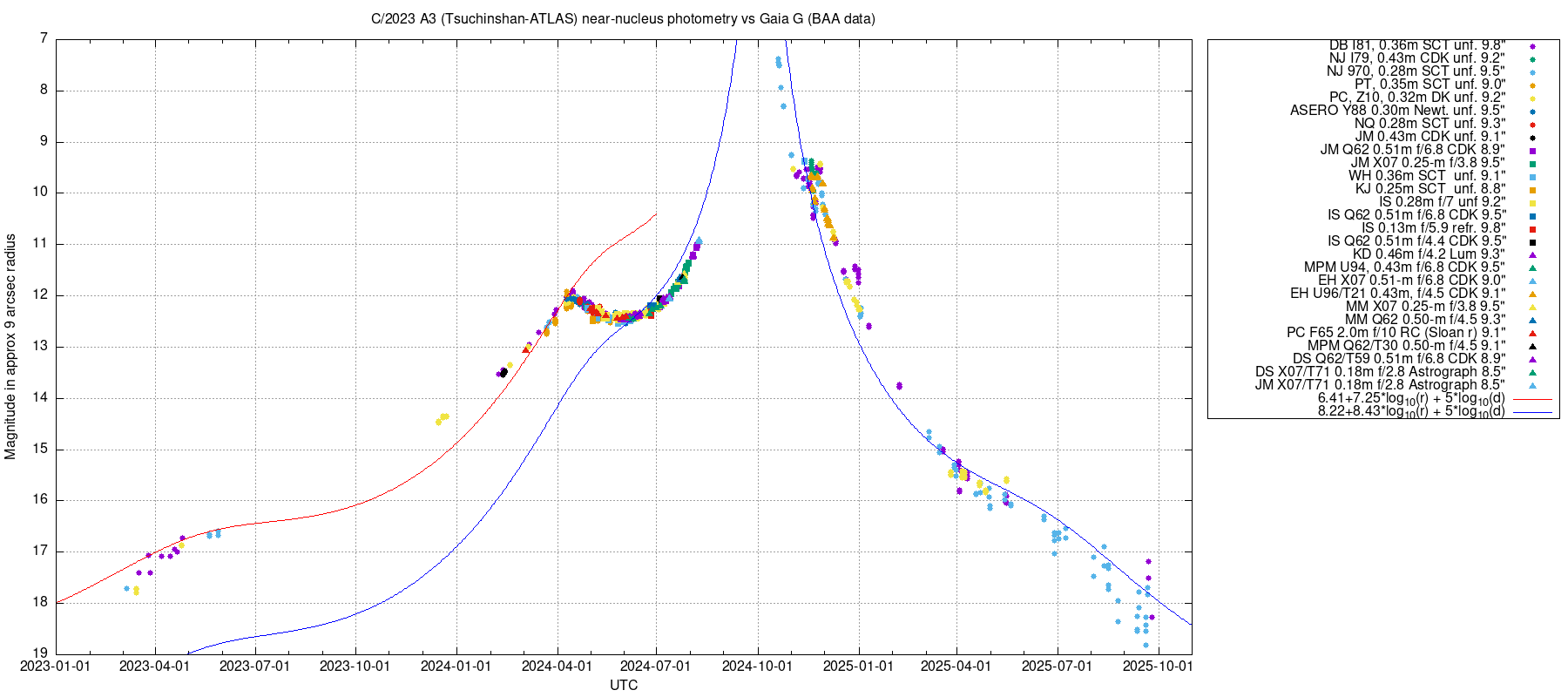
C/2023 A3 (Tsuchinshan-ATLAS) lightcurve
Nick James 31 Oct 2025 18:38 UTC
With all the current excitement about C/2025 A6 (Lemmon) we shouldn't
forget the much brighter comet that we had this time last year. C/2023
A3 was a really impressive naked-eye object in mid-October 2024 but it
has now faded to around 18th magnitude although it is still available in
the evening sky.

In response to a query from Jonathan Shanklin I have updated the 9
arcsec lightcurve. The lightcurve of this comet is very unusual. The
blue curve shows a simple fit to the data points from 2024 July 1
onwards. It is a passable, although not very good, fit. The period up to
2024 April has a rather poor fit to a different curve. The peak around
2024 April 15 is supposed to be mainly due to the phase angle effect on
the very dusty tail which, at that time, was projected behind the comet,
but that doesn't really explain why the comet was a lot brighter
throughout the period up to 2024 April.

Jonathan specifically requests if there are any images that can provide
data in 2025 January. The comet was at a small elongation then and was
moving from the evening to the morning but if you do have any images
which you haven't measured and submitted then please contact me.

It is worth keeping this comet under observation and submitting your
photometry results. The recent large scatter in data is probably due to
the very crowded field and the high probability that faint stars are in
the 9 arcsec radius aperture.

Nick.

 Show/hide attachments