Re: [BAA Comets] Re: [comets-ml] 2007 HE4
Nick James 28 Jul 2024 21:36 UTC
Maik,

That's a great piece of detective work. I've had a play around with the
available astrometry using Bill Gray's Findorb and I agree that the
linkage looks secure.

This is a really interesting result for me since, as Richard mentioned,
Denning was the first BAA Comet Section director (1891-1893). That was
12 directors ago:

https://britastro.org/section_information_/comet-section-overview/history-of-the-baa-comet-section

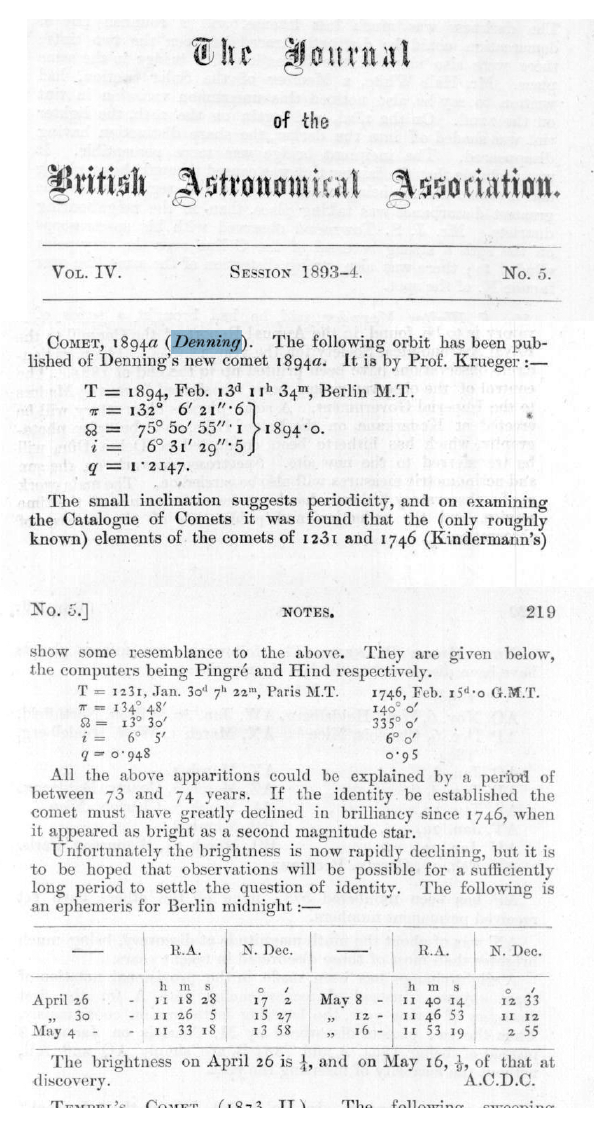
D/1894 F1 was his fourth and final comet and it's great to have it back
again! The attached is a contemporary report from the JBAA. ACDC is
third director of the section, Andrew Crommelin.

I'm putting together a news item for the BAA website. It is not often
that a lost comet is found again, particularly one with such a
connection to the BAA.

Thanks again for the great work.

Nick.

On 28/07/2024 17:37, Maik Meyer wrote:
> Hello Richard,
>
>> O.K. Sam -  I hadn’t picked up the fact that the spread of
>> observations during the 30-day arc was very poor. That explains it in
>> that the MPC and JPL ephemerides are different because of the actual
>> observations employed along with any weighting factors, etc. also differ.
>>
>> Given Maik’s linkage, when do you think we can expect the new orbit to
>> be published so that we can then plan an observing campaign to recover
>> the object?
>
> Personally, I think the linkage is safe. It would be a very big
> coincidence to have 2007 HE4 moving on a perfectly fitted arc of one
> month without systematic deviations which are usually a tell-tale sign
> of an incorrect link.
>
> I have also checked several logbooks of observatories for possible
> observations, especially of the favourable apparition of 1963/64, but
> was not successful. Elizabeth Roemer missed it by 2.3 degrees on 1964
> Feb 4, when she was imaging 59P/Kearns-Kwee. Denning would have been
> then maybe of magnitude 14-15.
>
> Unfortunately, 1964 not many surveys were operating, POSS I was already
> over. But it is not astonishing to miss such a faint comet, there are
> many which have been missed that were even brighter.
>
> I think the final decision will be the next perihelion. It is not
> perfect but also not awfully bad and it may reach 18 mag or brighter.
> Here's an orbit for this epoch.
>
> Orbital elements:  D/1894 F1
>     Perihelion 2025 Dec 4.06727 TT =  1:36:52 (JD 2461013.56727)
> A1: -3.83e-9    A2: 3.58e-10  AU/day^2
> Epoch 2025 Dec  1.0 TT = JDT 2461010.5   Earth MOID: 0.5820   Ju: 0.0606
> M 359.67526526                      Ma: 0.0222                   Meyer
> n   0.10587093     Peri.  109.41912
> a   4.42538997     Node    20.62196
> e   0.6471858      Incl.    4.02545                       (J2000 ecliptic)
> P   9.31           H   15.0     G   0.15   q 1.56134008  Q 7.28943986
> 242 of 312 observations 1894 Mar. 27-2007 May 18; mean residual 3".28
>
> I think it would be good to publish an orbit for folks to be aware and
> try to recover it early.
>
> Regards
>
> Maik

 Show/hide attachments